


Al Capone's Walnut Pasta Sauce Recipe
There is something special about bringing an old recipe back to life, especially when that recipe has a connection, whether historical or legendary, to one of the most infamous names in American history.

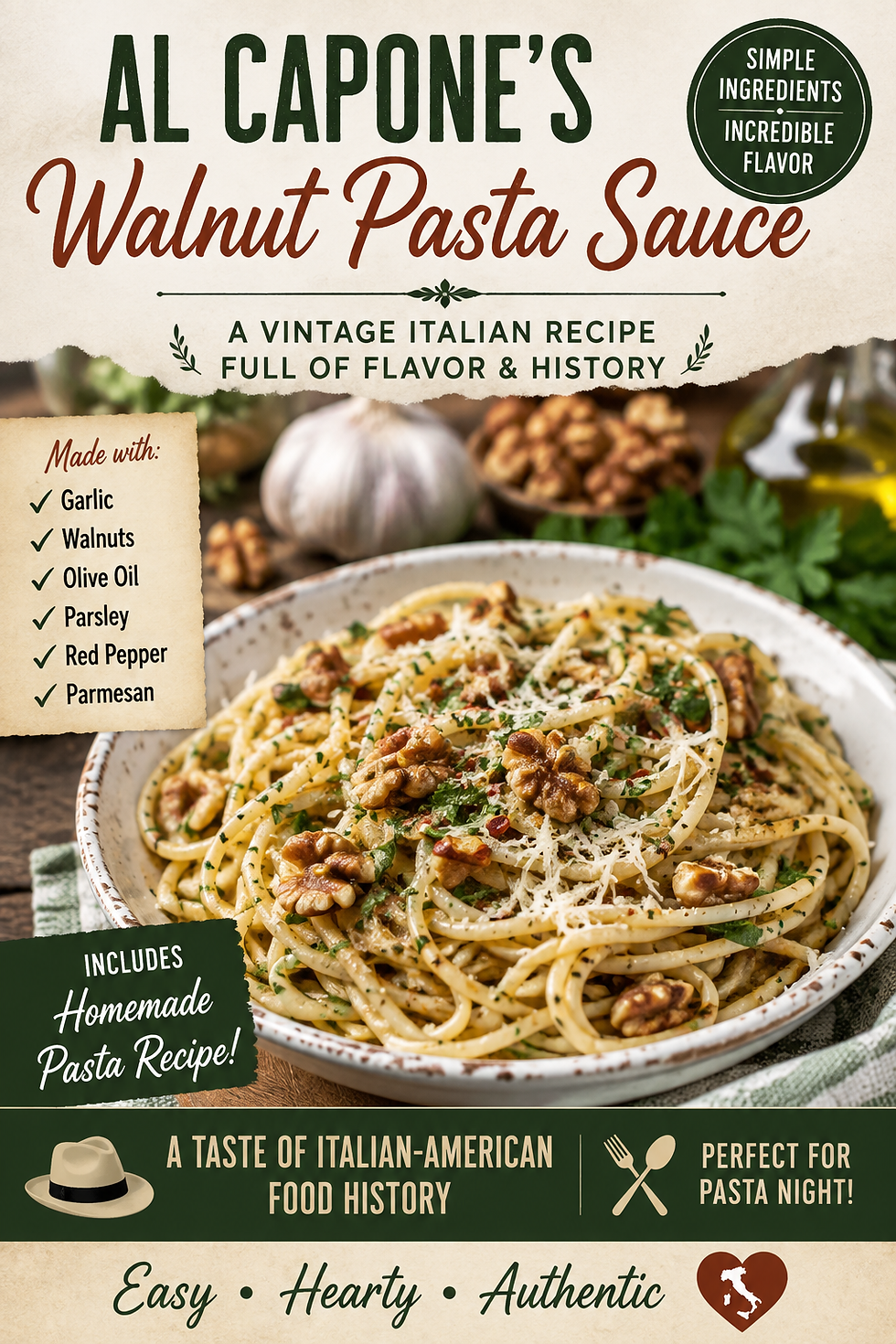
For this adventure in the kitchen, we decided to make **Al Capone’s Walnut Pasta Sauce**, a simple but incredibly flavorful Italian-inspired dish featuring garlic, olive oil, walnuts, parsley, red pepper, and Parmesan cheese. And because we wanted to experience the recipe the old-fashioned way, we did not stop with the sauce. We also made our pasta from scratch.
Al Capone remains one of the most recognizable figures of the Prohibition era. His name immediately brings to mind Chicago, speakeasies, bootlegging, organized crime, and the violent battles that accompanied the illegal liquor trade of the 1920s. But behind the larger-than-life gangster persona was a man born into an Italian immigrant family, and food was naturally an important part of that family culture.
Recipes attributed to famous historical figures can sometimes be difficult to authenticate. Over the years, dishes become associated with celebrities, politicians, gangsters, and other well-known personalities through family stories, cookbooks, restaurants, newspaper articles, and simple word of mouth. Whether this exact walnut pasta preparation regularly appeared on Al Capone's dinner table is difficult to prove. What makes the recipe particularly striking is that its ingredients and preparation are firmly rooted in the type of simple Italian cooking that could have been familiar to families of his generation.
What immediately caught our attention about this recipe was the absence of one ingredient most Americans probably expect when they hear the words pasta sauce: tomatoes. This is not a thick red sauce simmering on the stove for hours. Instead, olive oil becomes the foundation of the sauce, carrying the flavors of garlic, walnuts, parsley, and crushed red pepper throughout the pasta.
The walnuts are what truly set the dish apart. They add texture, richness, and an earthy flavor that works surprisingly well with the garlic and olive oil. Toasting them briefly in the hot oil helps bring out even more of their flavor. By the time everything comes together, you have a pasta dish that requires relatively few ingredients but tastes far more complex than you might expect.
We started with the pasta itself. Our homemade pasta recipe uses just four basic ingredients: **2 cups of all-purpose flour, 3 large eggs, ½ teaspoon of sea salt, and 2 tablespoons of extra-virgin olive oil**. Making pasta by hand can look intimidating if you have never tried it before, but the process is actually fairly straightforward. It just requires a little patience and some work.
We began by placing the flour on a clean work surface and forming it into a nest with a depression in the center. Into that center went the eggs, olive oil, and salt. Using a fork, we broke up the eggs while trying to keep the walls of flour intact. Gradually, we pulled more flour toward the center until the ingredients began coming together into a dough.
This is the point where you might start questioning whether you have done something wrong. The dough can initially seem dry, crumbly, and completely unwilling to cooperate. Keep working it. Once we had formed a rough ball, we kneaded the dough for about eight to ten minutes. Slowly but surely, the texture changed, and the dough became smooth and cohesive. If the dough becomes a little too dry while kneading, simply wetting your fingertips can introduce enough moisture to help bring everything together.
Once the dough was ready, we formed it into a ball, wrapped it in plastic wrap, and allowed it to rest at room temperature for about 30 minutes. That resting period is important because it gives the dough time to relax, making it much easier to roll. After the 30 minutes were up, we divided the dough into four smaller pieces so they would be easier to work with.
You can certainly use a pasta roller or a mixer attachment for the next step, but there is something satisfying about doing it entirely by hand. Using a rolling pin on a lightly floured surface, we rolled each piece of dough as thin as possible. It takes a little effort, but the process is the time-honored method families used long before electric mixers and pasta attachments became common kitchen appliances.
Once the pasta sheet reached the thickness we wanted, we lightly dusted the top with flour and loosely rolled it up almost like a kolachi, nut roll, or pumpkin roll. We then sliced across the roll to create individual noodles. One of the great things about making your own pasta is that there really is no rule saying every strand needs to look exactly the same. You can make spaghetti, fettuccine, or wider noodles, or even use the dough for ravioli. After cutting the pasta, we used our fingers to gently fluff and separate the strands before repeating the process with the remaining dough.
Fresh pasta cooks incredibly quickly compared with the dried pasta most of us keep in the pantry. Depending on the thickness and shape of the noodles, they may need only one to three minutes in salted boiling water. If you decide not to make the pasta from scratch, the walnut sauce works perfectly well with one pound of dried spaghetti cooked according to the package directions. Either way, reserve about half a cup of pasta water before draining your noodles. That starchy water can be useful if you need to loosen the sauce later.
With the pasta ready, it was time for the star of the recipe. For the walnut sauce, we used **6 cloves of chopped garlic, 1½ to 2 cups of extra-virgin olive oil, 1 cup of chopped walnut pieces, 1 cup of chopped parsley leaves, 1 teaspoon of crushed red pepper, salt, freshly ground black pepper, and grated Parmesan cheese**. It is a short ingredient list, which means each ingredient gets an opportunity to contribute to the finished dish.
We heated the olive oil over medium heat in a large skillet and added the chopped garlic. The garlic only needs about one or two minutes at first. You want it to release its flavor into the oil without allowing it to burn. Burned garlic can quickly become bitter, so this is one part of the recipe where it pays to stay near the stove and keep an eye on the pan.
Next came the chopped walnuts. We stirred them into the garlic and olive oil and allowed everything to cook together for another two or three minutes. The goal is for the garlic to begin taking on approximately the same golden color as the walnuts. At that point, the kitchen smells fantastic. The combination of toasted walnuts, garlic, and warm olive oil creates an aroma that makes you understand why such simple recipes have survived for generations.
The chopped parsley and crushed red pepper were added next. The parsley brings freshness to an otherwise rich dish, while the red pepper provides just enough heat to keep things interesting. You can adjust the amount of crushed red pepper depending on your preference. Those who enjoy a little more heat can certainly add extra, while anyone who prefers a milder dish can reduce the amount.
We then added the cooked pasta directly to the skillet and tossed everything together, coating the noodles in the walnut, garlic, and olive oil mixture. This is where that reserved pasta water can come in handy. If everything seems a little too dry or the sauce is not coating the pasta the way you would like, a small splash of pasta water can help bring the ingredients together. Once everything was thoroughly combined, we seasoned the pasta with salt and freshly ground black pepper to taste.

This recipe is featured in our recipe book. Click the image to see on Amazon.
The final step was plating the pasta and adding a generous sprinkle of grated Parmesan cheese. There is no heavy cream, complicated reduction, or long list of seasonings hiding behind the primary ingredients. You taste the garlic. You taste the walnuts. You taste the olive oil, parsley, Parmesan, and gentle heat from the red pepper. It is rustic, hearty, and surprisingly satisfying.
Recipes like this are one of the reasons we enjoy exploring food history. Cooking a vintage or historically inspired recipe gives you another way to connect with the past. History is not limited to battlefields, old buildings, cemeteries, museums, and famous events. History also happened around kitchen tables. People cooked meals, passed recipes through generations, experimented with available ingredients, and created food traditions that survived long after they were gone.
That is also part of the idea behind **Our Haunted Travels, Haunted History Recipes**. Throughout our travels, we have encountered fascinating stories, historic locations, unusual legends, and connections to food that inspired us to start collecting recipes with ties to the people, places, and periods we explore. If you enjoy vintage recipes, Italian cooking, food history, and discovering something a little different in the kitchen, Al Capone’s Walnut Pasta Sauce is definitely worth trying.
You can watch the video to follow along as we prepare the pasta and walnut sauce from scratch. And if you try the recipe yourself, let us know what you think. We would also love to hear about the recipes that have been passed down through your own family. Sometimes the best history is not found in a textbook. Sometimes it is written on a stained recipe card tucked away in a kitchen drawer.
If you enjoy our adventures, be sure to like the video, subscribe to **Our Haunted Travels**, and leave us a comment. And if you would like your own copy of **Our Haunted Travels, Haunted History Recipes**, the book is now available on Amazon. It contains another way to explore history with us—this time from the kitchen. Whether Al Capone himself would have approved of our version of walnut pasta is something we will never know, but after tasting it, we can certainly understand why a dish like this has earned a place at the table.


Comments