


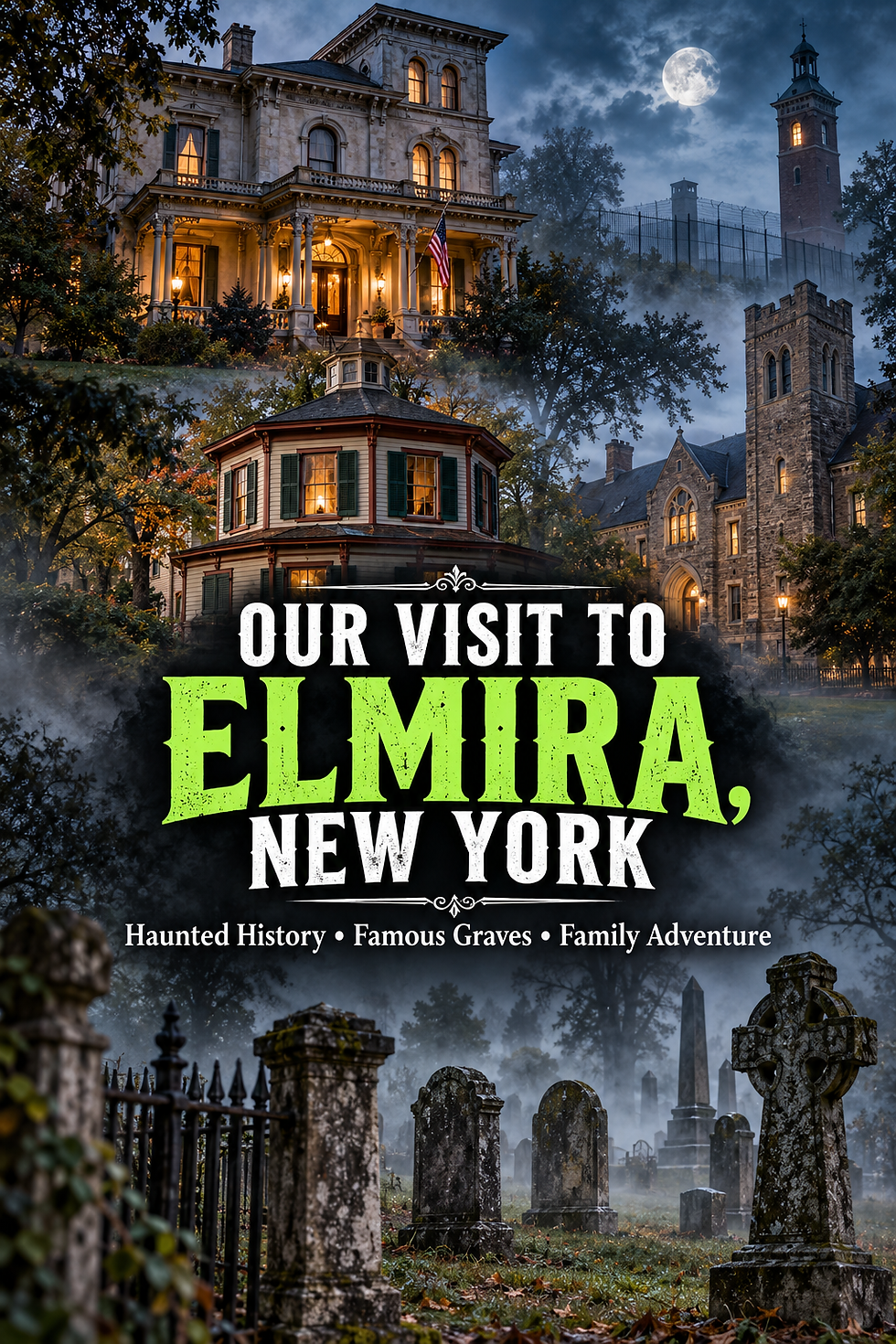
Our Visit to Elmira, New York
On July 10, 2026, we set out to explore Elmira, New York, but this particular day was about much more than adding another group of historic and haunted locations to our growing list. Our visit had two equally important purposes. The first was to spend time with Shawn’s niece, Bella, who had recently moved to the Elmira area. The second was to visit several locations connected to the city’s history, tragedies, famous residents, and lingering ghost stories. As it turned out, the two parts of the day blended together perfectly and gave us memories that went far beyond the places we filmed.

Elmira is the kind of city that can surprise you if you only know it as a name on a map. Located in New York’s Southern Tier, not far from the Pennsylvania border, it has a long and complicated past. The city has connections to the Civil War, the Underground Railroad, American literature, college history, professional sports, comedy, aviation, and countless local stories that have been passed down through generations. Some of those stories are inspiring. Others are tragic. A few have become part of Elmira’s haunted reputation.
We began our day by driving to Bella’s new home and picking her up so she could ride along with us. Because these locations were now in her town, we thought it would be interesting for her to see them and learn a little about the history surrounding her new community. At first, Bella was simply coming along to spend the day with us. It did not take long, however, before she became part of the production.
As we moved from one stop to the next, Bella began helping us record video. She listened as we talked about the locations, watched how we framed our shots, and stepped in to help capture footage. What began as a sightseeing trip quickly became a small family filming adventure. Having her involved made the day more relaxed and personal. Instead of simply rushing from place to place and checking locations off a list, we were sharing the experience with someone who mattered to us.
Stop One: Lindenwald Haus Inn
Our first stop was the Lindenwald Haus Inn. Historic inns naturally invite the imagination. Over the years, they welcome countless travelers through their doors, each person bringing a story and leaving some small part of it behind. The older the building, the easier it is to wonder about all the conversations, celebrations, arguments, illnesses, reunions, and farewells that may have happened inside.
The Lindenwald Haus Inn gave us an atmospheric beginning to our tour. Even before discussing any ghost stories, the building had the kind of presence that makes you pause and look more carefully. Historic structures are visual records of the communities around them. Their walls survive while generations of owners, employees, guests, and neighbors come and go. Details that may seem ordinary at first can suddenly feel important when you realize how many years they have endured.
As we recorded the exterior and introduced the location, we talked about the reports that have contributed to its haunted reputation. As with many privately owned historic properties, paranormal claims can change depending on who is telling the story. Some accounts grow from personal experiences, while others are passed from one visitor to another until they become part of local folklore. The important thing for us was not to declare that every story was unquestionably true. We wanted to document the location, acknowledge the reports, and allow viewers to decide what they believed.
Because it was our first stop, it also gave Bella an introduction to how we approach this kind of filming. A haunted location video is not only about pointing a camera at an old building and saying that ghosts are present. We look at the history, the setting, the people associated with the property, and the reasons the stories may have survived. The paranormal claims are one layer of a much larger story.
The Lindenwald Haus Inn started our day with exactly the right tone. It was historic, mysterious, and visually interesting, but it also encouraged us to slow down and pay attention. There is always a temptation during a busy travel day to hurry, especially when several stops remain. This first location reminded us that each site deserves its own moment.
Stop Two: Fire Station No. 4
Our second stop was Elmira’s Fire Station No. 4. Old firehouses possess a very different atmosphere from historic inns. An inn was built to provide comfort and rest, while a fire station was designed around readiness, danger, and sudden action. For generations of firefighters, the sound of an alarm could instantly transform an ordinary day into a race toward someone else’s emergency.
Fire Station No. 4 represents the public-service side of Elmira’s history. Buildings like this were more than places to store equipment. Firefighters spent long hours together inside them, sharing meals, maintaining gear, waiting for calls, and forming bonds that often resembled family relationships. In earlier eras, firefighting was even more physically dangerous than it is today. Protective equipment was limited, communications were slower, and buildings could become deadly without warning.
That history makes old fire stations natural settings for ghost stories. Locations connected with intense emotion, constant vigilance, injury, and loss often develop paranormal reputations. Visitors and employees at supposedly haunted firehouses commonly describe unexplained footsteps, voices, shadows, doors moving without an obvious cause, or the impression that someone is still carrying out an old routine. Whether such experiences are paranormal, environmental, or products of expectation, they become attached to the building’s identity.
At Fire Station No. 4, we focused on telling the story respectfully. Firehouses are not theatrical haunted attractions. They represent real people who accepted dangerous responsibilities for their community. If the building does retain an unexplained presence, it is tempting to imagine that it may be connected to someone who once knew the station as a second home.
Bella continued helping us capture footage, and by this point she was becoming more comfortable with the process. She was no longer simply waiting for us to finish. She was watching what we needed and helping us tell the story. That changed the entire rhythm of the visit. We were not only documenting Elmira’s haunted locations. We were showing Bella another side of what we do when we travel.
Stop Three: Elmira College
Our third stop took us to Elmira College, a location where history, education, architecture, and folklore come together. Founded in 1855, Elmira College was established as an institution intended to provide women with a serious course of study comparable to what men received at the time. That mission gave the college an important place in the history of women’s higher education.
The campus has the kind of historic architecture that makes it easy to feel connected to earlier generations. Students have crossed these grounds for well over a century. They arrived with ambitions, fears, friendships, personal struggles, and plans for the future. Faculty members devoted their careers to the institution, while buildings were expanded, renovated, repurposed, and preserved. Each generation changed the college, but it also inherited traditions from those who came before.
Elmira College is also closely connected with Samuel Clemens, better known as Mark Twain. Clemens married Olivia Langdon, whose family lived in Elmira, and he spent many summers in the area. On Quarry Farm, overlooking the Chemung River Valley, he worked in the famous octagonal study where he wrote portions of some of his best-known books. That study was later moved to the Elmira College campus, where it remains one of the city’s most recognizable literary landmarks.
Standing near the study creates an unusual connection between the physical world and the world of imagination. It is a small structure, but some of America’s most enduring characters and stories took shape within it. Mark Twain wrote with humor, criticism, observation, and an understanding of human nature that continues to resonate. Elmira was not simply a place he occasionally visited. It became an important part of his family life and creative work.
Like many old colleges, Elmira College has accumulated ghost stories. Campuses provide ideal conditions for folklore because every new group of students inherits stories from the classes ahead of them. A strange noise in a residence hall, an unexplained figure near an old building, or an unsettling late-night experience can be repeated for decades. The details may change, but the central legend remains.
We discussed those stories while also appreciating the larger history of the campus. It is easy for a paranormal story to overshadow everything else, but the best haunted histories are grounded in the lives of real people. At Elmira College, the stories exist alongside a pioneering educational legacy and a remarkable connection to one of America’s most famous writers.
For Bella, this stop offered another look at the history hidden in familiar surroundings. A college campus can appear to be simply a collection of classrooms and residence halls until you begin learning who walked there and what happened over the decades. Once those stories are known, the landscape changes. Buildings become chapters, and even a small study can become a doorway into literary history.
Stop Four: Elmira Civil War Prison Camp
Our fourth stop was the most sobering location of the day: the site of the Elmira Civil War Prison Camp. During the Civil War, the camp held more than 12,000 Confederate prisoners. Nearly 3,000 died during its roughly one year of operation. The terrible conditions and high death rate eventually earned the prison the grim nickname Hellmira.
The property had originally been used as Camp Rathbun, a training and mustering location for Union soldiers. When it was converted into a prison camp in 1864, the existing facilities were not prepared to support the number of men eventually sent there. Thousands of prisoners arrived rapidly, and many initially lived in tents because there was not enough barrack space.
Overcrowding was only part of the problem. Disease spread through the camp, food and clothing were inadequate, and Elmira’s harsh winter intensified the prisoners’ suffering. A nearby body of water known as Foster’s Pond became associated with poor sanitation and illness. A flood in March 1865 made conditions even worse. By the time the camp closed, almost one out of every four prisoners held there had died.
One of the most disturbing aspects of the Elmira prison story is that spectators reportedly paid to watch the prisoners from elevated observation platforms outside the camp. The suffering inside became a form of entertainment for some people beyond the walls. That detail says something deeply uncomfortable about human nature. The men were prisoners, but they were also sick, hungry, frightened human beings being watched during one of the worst periods of their lives.
Today, much of the original prison landscape has been absorbed into the modern city. Homes, streets, and businesses occupy areas where barracks, fences, guard towers, and tents once stood. Without historical markers and preserved memories, someone could pass through without understanding the scale of the tragedy that occurred there.
That contrast made the stop especially powerful. Everyday life now continues where thousands of men experienced confinement and where so many died. Cars travel nearby. People go to work. Families live their lives. Yet the history has not disappeared simply because the physical prison was dismantled.
It is not surprising that a place associated with so much suffering has inspired paranormal stories. People have reported uneasy feelings, unexplained sounds, apparitions, and the sense that the past remains close to the surface. No camera can prove what every visitor has experienced, but the emotional weight of the site is undeniable. Sometimes a location feels haunted because we know what happened there. Other times, visitors believe they encounter something that history alone cannot explain.
We approached this stop differently from the lighter portions of our day. The prison site did not need exaggeration or dramatic storytelling. The documented history was already tragic enough. Our purpose was to remember the people imprisoned there, explain the conditions they endured, and recognize that the city around the site grew while the memory of the camp became easier to overlook.
Stop Five: Lunch at the Ill Eagle Taphouse
After several hours of filming and the emotional weight of the prison camp, we were ready for a break. Our fifth stop was the Ill Eagle Taphouse, where we spent some time together and had lunch. This stop gave us an opportunity to sit down, relax, and enjoy one another’s company rather than immediately rushing to the next location.
Meals are often an overlooked part of travel stories, but they can become some of the most memorable moments. When we are filming, much of our attention is divided among cameras, batteries, microphones, notes, traffic, parking, weather, and time. Sitting down for lunch allowed us to stop thinking about the schedule for a little while and focus on being together.
The Ill Eagle also fit the character of our Elmira visit. It offered an interesting setting and its own sense of atmosphere, making it more than a random place to grab food. Of course, when we visit a building with history and personality, the possibility of a ghost story is never far from our minds. Old gathering places tend to collect stories because so many people pass through them and because employees become familiar with every normal sound the building makes. When something happens outside that familiar pattern, people notice.
Whether someone visits for the haunted reputation, the architecture, the food, or simply the name, the Ill Eagle Taphouse is the kind of place that becomes part of the day’s story. For us, it was where we recharged before the largest and final stop on our Elmira itinerary.
By lunchtime, Bella had become a genuine member of our little crew. She had spent the morning traveling between locations, learning about Elmira, and helping with the videos. We were proud of how naturally she joined in. That family connection gave the meal more meaning and reminded us why we had planned the day in the first place.
Stop Six: Woodlawn Cemetery
Our final stop was Woodlawn Cemetery, one of Elmira’s most historically significant locations. Cemeteries are often described only as places of death, but they are also enormous archives of community history. Names carved into stone connect to wars, inventions, literature, civil rights, education, entertainment, athletics, family stories, and events far beyond the cemetery gates.
Woodlawn contains the graves of several nationally important figures, and we had a long list of people we hoped to visit. The cemetery demanded more time and attention than any other stop that day. It was not simply a matter of finding one famous grave, recording a quick clip, and leaving. Every person on our list represented a different chapter of history.
One of the best-known people buried there is Samuel Clemens, known throughout the world as Mark Twain. His connection to Elmira came through his wife, Olivia Langdon Clemens, and her family. Clemens spent many productive summers in the area and eventually chose Elmira as his final resting place. Visiting his grave completed the story we had begun earlier at Elmira College. We had seen the study connected with his writing, and now we stood at the place where he and members of his family were buried.
We also visited the grave of Hal Roach, a pioneering film and television producer whose career helped shape American comedy. Roach worked with performers whose names became legendary, including Laurel and Hardy and the children of the Our Gang series, later widely known as The Little Rascals. His grave links quiet Elmira soil to the history of Hollywood and to comedy that still makes audiences laugh generations later.
Another essential stop was the grave of John W. Jones. Jones escaped slavery in Virginia and made his way north, eventually settling in Elmira. He became an important conductor on the Underground Railroad and helped hundreds of freedom seekers continue their journeys toward safety. During the Civil War, he was also responsible for burying the Confederate prisoners who died at the Elmira camp.
Jones treated those men with care and maintained detailed records so their identities would not be lost. His work ensured that families could know where their loved ones had been buried. The contrast is extraordinary: a man who had escaped slavery respectfully buried soldiers who had fought for the Confederacy. His actions reflected dignity, humanity, and a commitment to honoring the dead even amid the divisions of war.
We also paid our respects to Catharine Beecher, a prominent nineteenth-century educator and writer. She came from the influential Beecher family and advocated for women’s education at a time when opportunities for women remained severely limited. Her work reflected the belief that women should receive meaningful intellectual training and that education played an essential role in shaping society.
The grave of Ernie Davis connected Elmira to sports history and the struggle for racial equality. Davis became the first Black athlete to win the Heisman Trophy. His talent made him a football legend, but his character and perseverance made his story even more powerful. He faced racism while competing at the highest level of college football, yet he carried himself with remarkable dignity. His professional future appeared bright when he was diagnosed with leukemia. He died in 1963 at only twenty-three years old, before he could play in a professional regular-season game.
Standing at his grave, it was difficult not to think about everything he accomplished in such a short life and everything he might have achieved if given more time. His story is triumphant and heartbreaking at the same time. He remains a source of pride for Elmira and an enduring figure in American sports.
Ross Gilmore Marvin represented another form of courage and exploration. Marvin participated in Robert Peary’s Arctic expeditions and was part of the dangerous effort associated with reaching the North Pole. The Arctic tested explorers with extreme cold, shifting ice, isolation, exhaustion, and the constant possibility of death. Marvin did not return home from the 1908 to 1909 expedition, and the circumstances surrounding his death became controversial. His memorial in Woodlawn preserves the name of an Elmira man connected to one of the most ambitious exploration stories of his era.
Moving among these graves made it clear how many different histories intersect in Elmira. Literature, silent film, the Underground Railroad, women’s education, college football, Arctic exploration, and the Civil War all converge within the same cemetery. These people did not share one profession or one life experience. What they share is a connection to Elmira and a final resting place at Woodlawn.
Woodlawn also has a paranormal reputation, which is not unusual for a large historic cemetery. Visitors sometimes describe shadowy figures, strange sounds, unexplained lights, or the feeling of being watched when no one else appears to be nearby. Cemeteries naturally heighten the senses. Wind through the trees, distant voices, wildlife, shifting light, and the knowledge of being surrounded by generations of the dead can all influence how a person experiences the landscape.
Still, we never visit cemeteries merely to chase a frightening story. These are places of remembrance. Every marker represents a person, including thousands who were never famous outside their own families. We record with respect, remain mindful of other visitors, and try to leave the grounds exactly as we found them. The historical value of Woodlawn would be extraordinary even if no ghost story had ever been told about it.
By the time we finished at the cemetery, we had covered a tremendous amount of history. It had been a full day of driving, walking, filming, learning, and spending time together. Bella had stayed with us through inns, firehouses, college grounds, a Civil War prison site, lunch, and a large cemetery. Even better, she had helped us document the journey.
Ending the Day with Family

After leaving Woodlawn Cemetery, we returned to Bella’s house and finished the day by spending more time with her. That quiet ending was important. Our travels often revolve around schedules and locations, and it is easy to measure a successful day by how much footage we recorded. July 10 reminded us that some of the best parts of travel cannot be measured in minutes of video.
Yes, we visited six locations. We learned about haunted inns, old fire stations, a historic college, one of the Civil War’s deadliest prison camps, an atmospheric tavern, and a cemetery filled with remarkable people. We captured material that could become several different videos. We added more pieces to our continuing effort to document historic and paranormal locations.
But we also spent the day with Shawn’s niece. We explored her new town together. We watched her go from passenger to camera helper, and we created a family memory in the process. Years from now, we may remember a particular fact about Mark Twain, John W. Jones, or the Elmira prison camp. We may remember a strange feeling at one of the supposedly haunted locations. More than anything, however, we will remember that Bella was there with us and became part of the adventure.
Elmira proved to be a city with far more history than any single day could fully uncover. Beneath its modern streets are stories of courage, suffering, creativity, service, ambition, and loss. Some are preserved in museums and markers. Others survive in cemeteries, historic buildings, and local legends. A few linger in the form of ghost stories told by people who believe the past is not quite finished with the present.
Our visit on July 10 gave us only a glimpse of those stories, but it was enough to understand that Elmira deserves to be explored carefully. The city is not defined by one famous author, one tragic prison camp, or one haunted building. Its identity is made from all of those histories layered together.
For us, that is what makes a location worth visiting. History is never just a collection of dates. It is made of people, choices, hardships, accomplishments, and memories. Paranormal legends add another layer by showing how strongly certain places continue to affect those who encounter them. Whether the ghosts are literal spirits or echoes created by storytelling and emotion, they keep people asking questions about what happened before us.
As we ended the day at Bella’s home, Elmira no longer felt like simply another stop on our summer travels. It had become part of our family story. We arrived hoping to visit haunted locations and spend time with someone we love. We left with hours of footage, a deeper appreciation for the city, and a memory that connected history, the paranormal, and family in a way we could never have planned completely in advance.
That was our visit to Elmira, New York: six fascinating locations, centuries of history, a few ghost stories, and one very special day with Bella.


Comments