


The First Case to Use DNA
- Jul 20, 2016
- 3 min read
We will be discussing the case of Collin Pitchfork and how the use of DNA was implemented for the first time to free a man who actually made a confession to murder and turned around and found the right murderer for this serial killing case. DNA was used to solve the murders of Dawn Ashworth and Linda Mann.
We hope you enjoy the discussion on this episode of this podcast.
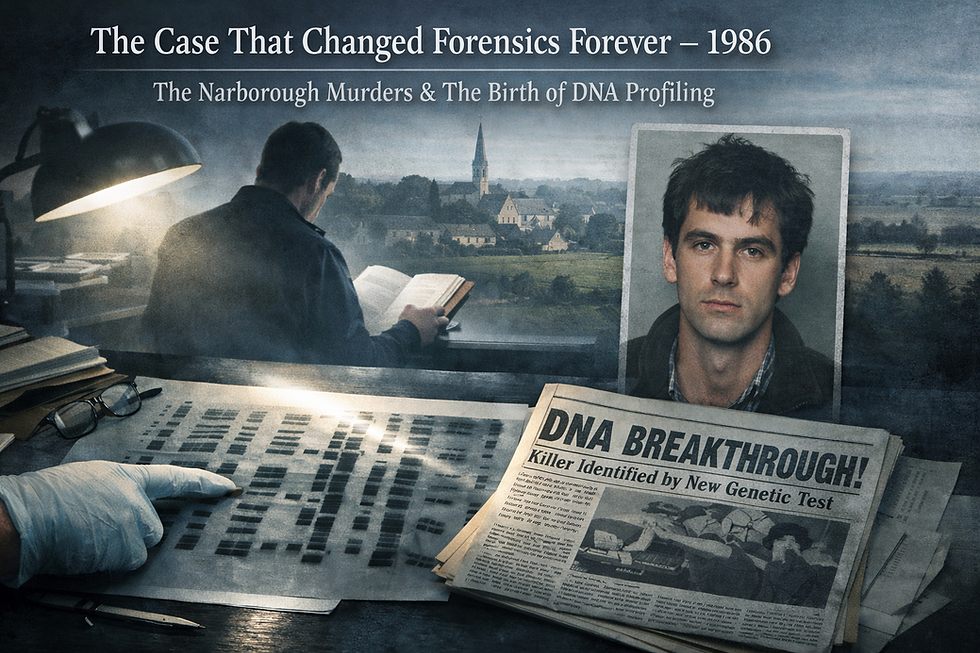
The case of **Colin Pitchfork** marked a turning point in criminal justice history. In the mid-1980s, the quiet villages of Narborough, Enderby, and Littlethorpe in Leicestershire, England, were shaken by two horrific crimes. What began as a tragic investigation into the assault and murder of a teenage girl would ultimately become the first criminal case in the world solved using DNA profiling. The scientific breakthrough not only identified a killer but also forever changed forensic investigations worldwide.
On November 21, 1983, fifteen-year-old **Lynda Mann** was found dead in a wooded footpath near Narborough. The attack was brutal, and investigators struggled to find solid leads. Three years later, on July 31, 1986, another fifteen-year-old, **Dawn Ashworth**, was murdered in a strikingly similar manner not far from where Lynda had been killed. The similarities between the crimes strongly suggested a single perpetrator.
Police arrested a local seventeen-year-old, **Richard Buckland**, after he made statements that appeared to indicate knowledge of Dawn Ashworth’s murder. Buckland even confessed during questioning. However, investigators were uneasy. His confession did not fully align with all the forensic details, and many suspected he might be vulnerable or easily pressured. Authorities needed stronger evidence to confirm whether they had the right person.
At this critical moment, a revolutionary scientific technique entered the case. British geneticist **Alec Jeffreys**, working at the University of Leicester, had recently developed a method known as DNA fingerprinting. In 1984, Jeffreys discovered that certain regions of human DNA are highly variable and unique to each individual—essentially creating a biological signature. Though initially used for immigration and paternity disputes, law enforcement quickly realized its potential for criminal investigations.
Investigators collected semen samples preserved from both crime scenes and asked Jeffreys to compare the genetic material. In a groundbreaking move, the DNA from the two murders was tested and matched—proving that both crimes had been committed by the same man. Even more astonishing, when Buckland’s DNA was tested, it did not match the crime scene samples. For the first time in history, DNA evidence exonerated a suspect, preventing a likely wrongful conviction.
With Buckland cleared, Leicestershire police launched the first mass DNA screening in criminal history. Beginning in 1987, they requested voluntary blood or saliva samples from over 5,000 local men between the ages of 17 and 34. The effort was unprecedented. Officers went door to door, carefully collecting and cataloging samples in hopes that the perpetrator would be among them. Despite the enormous undertaking, the killer initially evaded detection.
The breakthrough came not through the lab but through conversation. A bakery worker named Ian Kelly was overheard boasting in a pub that he had given a DNA sample on behalf of a coworker, Colin Pitchfork, who had asked him to impersonate him to avoid testing. Suspicious villagers reported the conversation to police. When authorities confronted Pitchfork and obtained his actual DNA sample, the results were conclusive—it matched the crime scene evidence perfectly.
In 1988, Colin Pitchfork pleaded guilty to the murders of Lynda Mann and Dawn Ashworth, as well as multiple sexual assaults. He was sentenced to life imprisonment. The conviction represented the first time DNA profiling had been used to both exonerate an innocent suspect and convict the true perpetrator. It proved that forensic genetics could be more reliable than eyewitness testimony or confessions alone.
The impact of the Pitchfork case extended far beyond Leicestershire. DNA profiling rapidly became a cornerstone of criminal investigations worldwide. Over time, forensic techniques evolved from the early, labor-intensive methods Jeffreys pioneered to faster and more precise DNA amplification processes. National DNA databases were eventually established in countries around the globe, fundamentally transforming law enforcement.
Today, the case of Colin Pitchfork stands as a watershed moment in the field and remains a pivotal moment that often demonstrated the power of scientific innovation to protect the innocent and hold the guilty accountable. While the crimes themselves remain tragic chapters in British history, the implementation of DNA profiling in this case ushered in a new era—one in which justice could be pursued not just through testimony and suspicion, but through the unalterable code written within our cells.


Comments